Portfolio
American Icon:
Terror On Repeat
ACCOUNTABILITY · INTERACTIVE · LONGFORM
Photo editing · Video editing · Story concept · Editorial project management
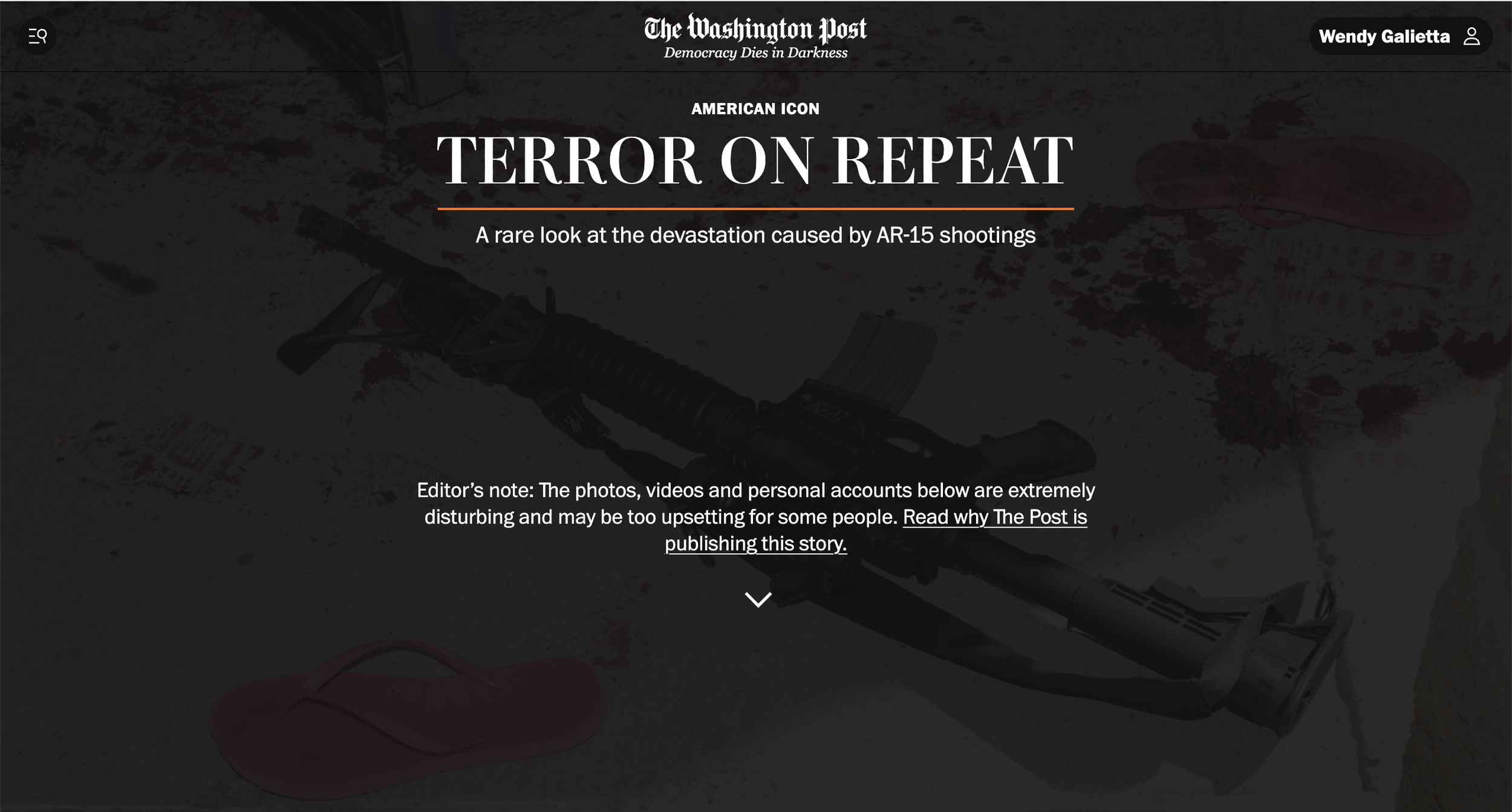
This story grew out of a question we kept coming back to: could we show what AR-15s do to bodies and the public spaces that are part of everyday American life, houses of worship, schools, theaters, malls. We had set out to be unflinching. The result was something more considered than that.
This landmark interactive story, which follows the chronological order of a AR-15 style rifle mass shooting, weaving together photographs, videos and first-person recollections from survivors of different tragedies who share hauntingly similar stories.
The central editorial challenge was balancing two objectives: advancing the public’s knowledge of the weapon’s lethality while remaining deeply sensitive to victims’ families and affected communities.
Producing this story also made clear that the journalists reviewing the photographs and video needed better support. I developed trauma-informed protocols for the full production team, from reporters and editors to the designers and copy editors. Anyone who worked on this story was folded into this process, giving the entire team shared language and a way to advocate for their own mental health.
A companion letter from the editor addresses the decisions behind publication. Letter from the editor: Why we are publishing disturbing content from AR-15 mass shootings
This series was awarded the 2024 Pulitzer Prize for Public Service.
American Icon:
The Blast Effect
ACCOUNTABILITY · DATA VISUALIZATION · INTERACTIVE
Animation editing · Photo editing · Video production · Text editing · Editorial project management
This single story was one of several stories developing simultaneously as part of the American Icon series, this one hadn’t quite found its angle yet.
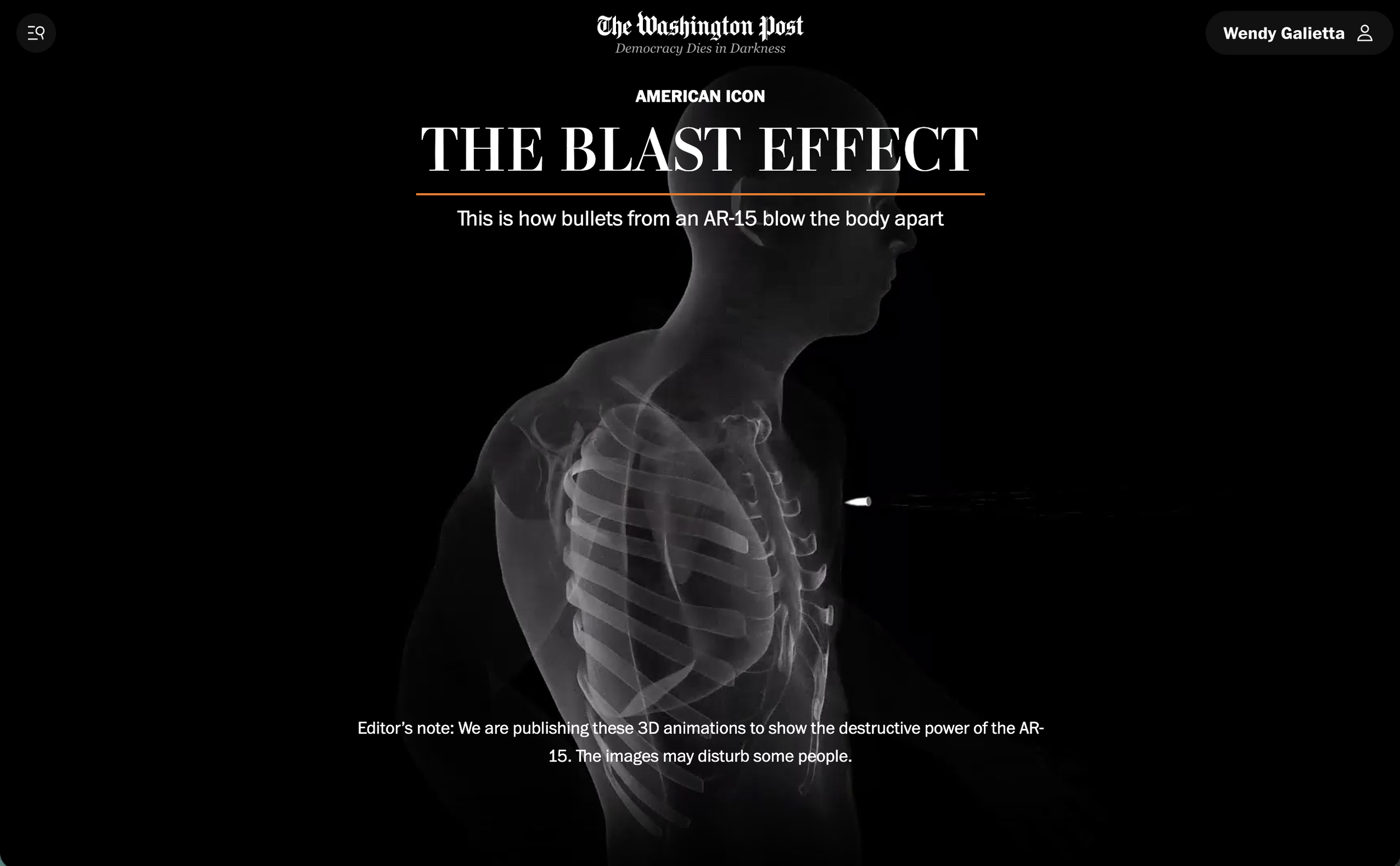
The two common existing approaches to visualizing AR-15 damage both fall short. Ballistic gel is too clinical and abstract. Crime scene photos are too graphic to publish, and even then they don’t show what’s actually happening inside the body.
I argued for a third way. Ground our illustrations in autopsy reports of shooting victims, showing the sonic wave effect of the high-velocity rounds tearing through arteries and the surrounding tissues and bone. That’s a unique part of what makes the AR-15 lethal — not just the size, but the speed. No existing visual had captured that truth. Basing the animations in forensic fact made it both more accurate and more devastating.
I brought in a senior editor to work alongside the writer. The reporting was strong but needed help finding its final shape. The three of us worked extensively to weave the text and narrative together to match the ambition and depth of the visuals.
The story published alongside a letter from the executive editor addressing the decisions behind publication. One of those decisions was rare and highly scrutinized: the depictions of specific young victims from Sandy Hook and Marjory Stoneman Douglas. That was possible because of consent. I helped reporters to build a network of families and shooting victim advocacy groups notified in advance of publication. They could then choose to prepare themselves or avoid the news cycle entirely. Creating that space, for dignity and consent around journalism needed to exist and was as important to me as any visual decision.
Letter from the editor: Why we are showing the impact of bullets from an AR-15 on the human body.
This series was awarded the 2024 Pulitzer Prize for Public Service.
Young and Navigating Cancer
HEALTH · MULTIMEDIA SERIES
Series visual direction · Photo editing · Video editing · Story development · Editorial project management
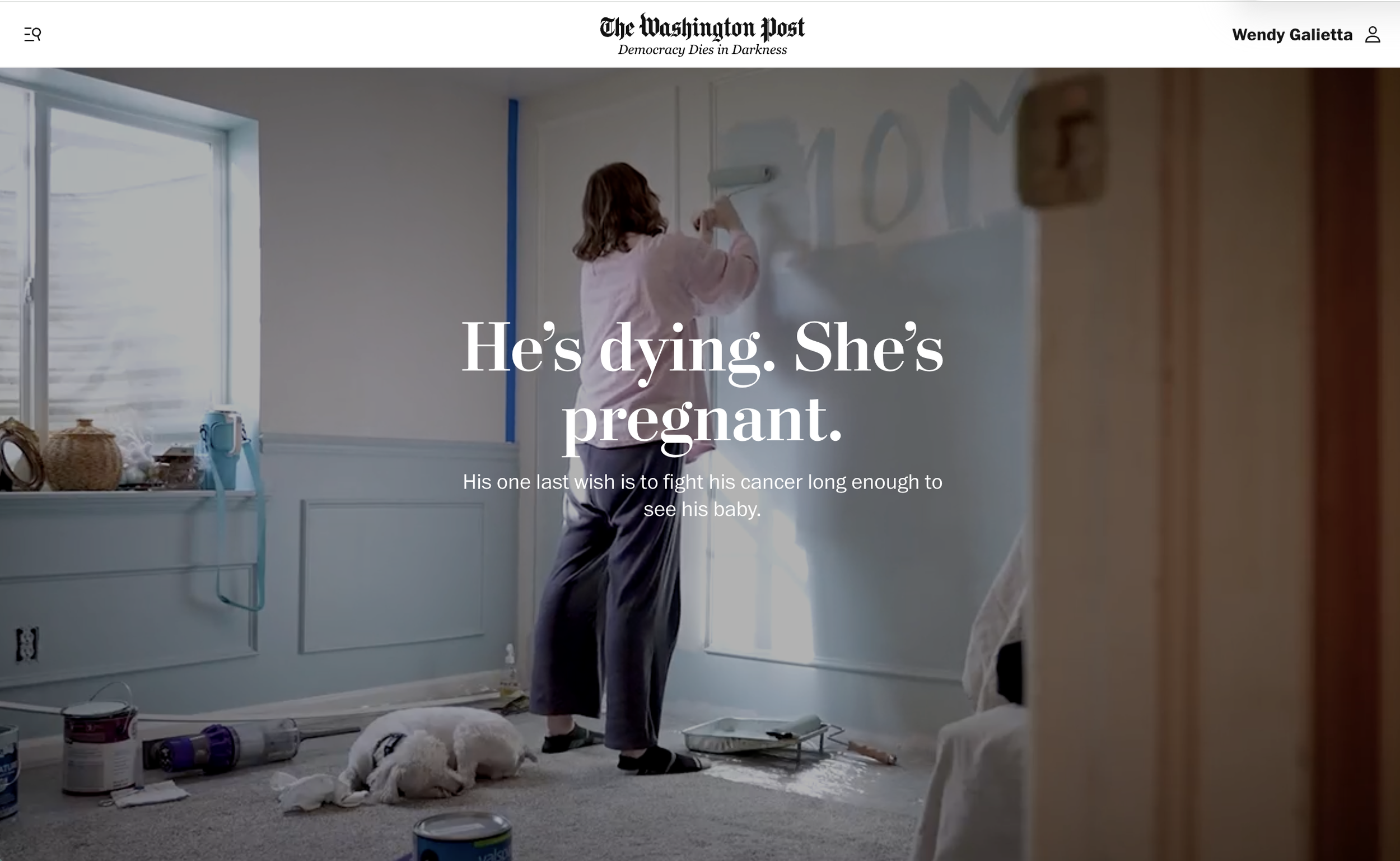
This award-winning multimedia series began with a clear trap to avoid. So often, cancer stories default to a visual language of hardship. Stark, somber, heavy. Tanner and Shay were living deliberately against that notion. They were growing their family, choosing joy, even as they planned for an end of life. The photography and video had to hold both truths at once.
The series was conceived by video journalist Drea Cornejo, who is herself navigating stage 4 lung cancer. It was personal before it was a project. I built a team of journalists who understood this unique world from the inside. My closest friend was diagnosed with stage 4 thymoma in her thirties. I know what it means to love someone who is fighting to stay and make their world special.
The central editorial argument I made was structural: the story had to move between photo and video, and that the emotional register had to follow Tanner and Shay’s lead. Dipping between grief and defiance, never settling into one.
Photography from this series by Jahi Chikwendiu was awarded the 2026 Pulitzer Prize for Feature Photography. This featured story was also recognized by the White House News Photographers Association and Pictures of the Year International in both photography and video categories in 2026.
Trans In America
LGBTQ+ · LANDMARK SERIES · LONGFORM
Series visual direction · Photo editing · Illustration editing · Story development
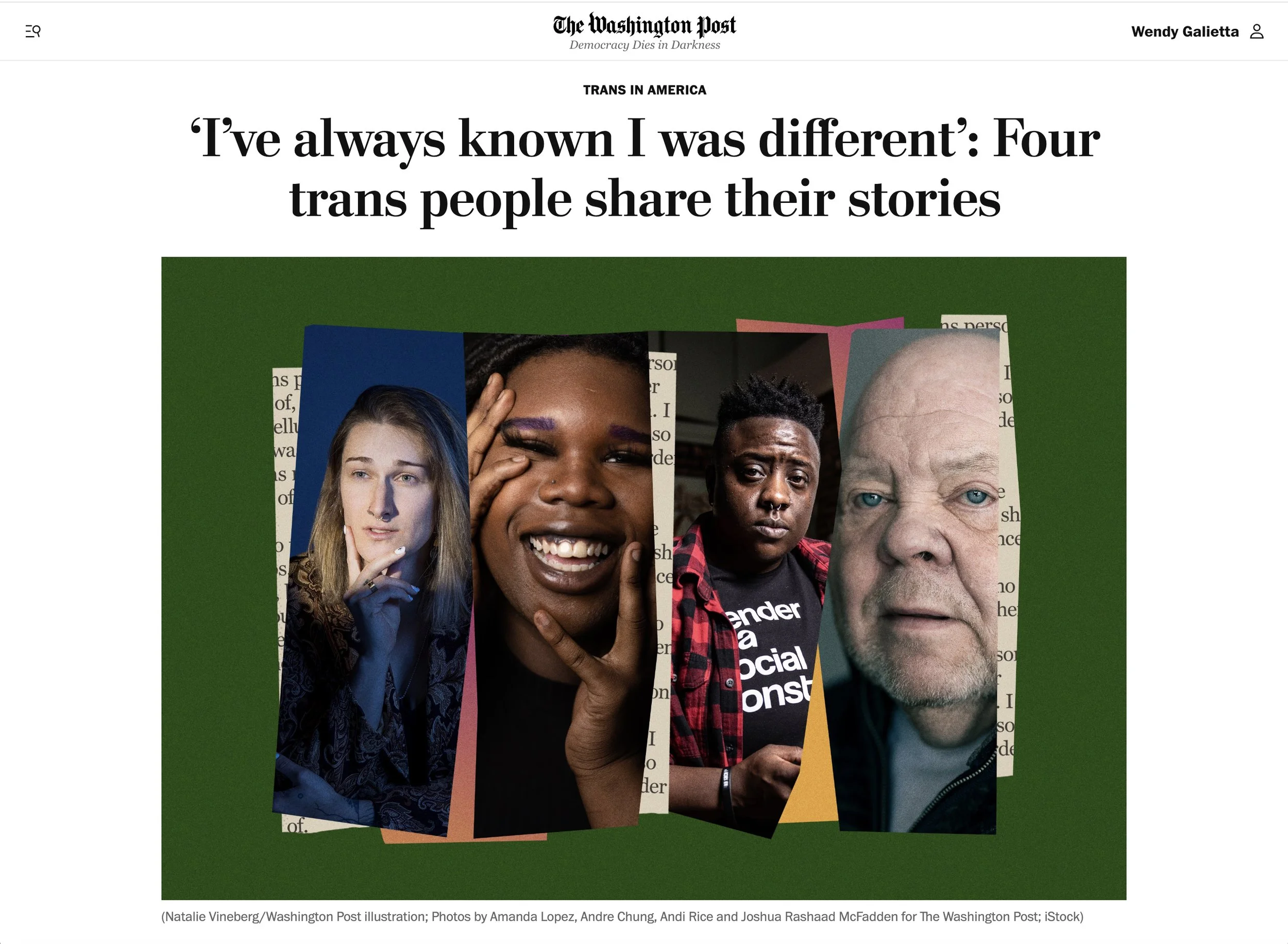
The central editorial tension on this series was one of representation. Not just who we reported on, but how. Transgender Americans are too often covered as a political abstraction or cultural flashpoint. The people who shared their stories with us deserved something different: journalism that treated their lived experience as the subject, not the controversy.
In collaboration with the Kaiser Family Foundation, we conducted the largest nongovernmental survey of transgender Americans ever undertaken. The visual work had to match that ambition. Specific, human and built on trust with the people who were asking to be seen.
This series was recognized with the NLGJA Excellence in Health or Fitness Coverage award in 2024.
Dying Early: America’s Life Expectancy Crisis
HEALTH · DATA · LONGFORM
Editorial project management · Photo editing · Visual editing · Visual story development
The scale of this series demanded structure. Dozens of reporters were working across 10 states, Europe and South America, examining why Americans are dying younger than people in peer nations. They found no single answer. Chronic illness, a fractured healthcare system, childhood poverty, decades old political decisions. The causes were many and so interconnected.
My job was to hold the human thread. With so many people at the center of the reporting, a major visual challenge was connecting readers to specific lives inside a sprawling data-driven investigation. I conceived, designed and wrangled the logistics of a character carousel as an entry point into the people behind the statistics.
During production I identified a significant permissions issue with the families who had shared their stories, requiring immediate intervention to protect both the people we had asked to be vulnerable and the publication.
This series was recognized with the Online News Association University of Florida Award for Investigative Data Journalism in 2024 and a First Place National Headliner Award, also in 2024.
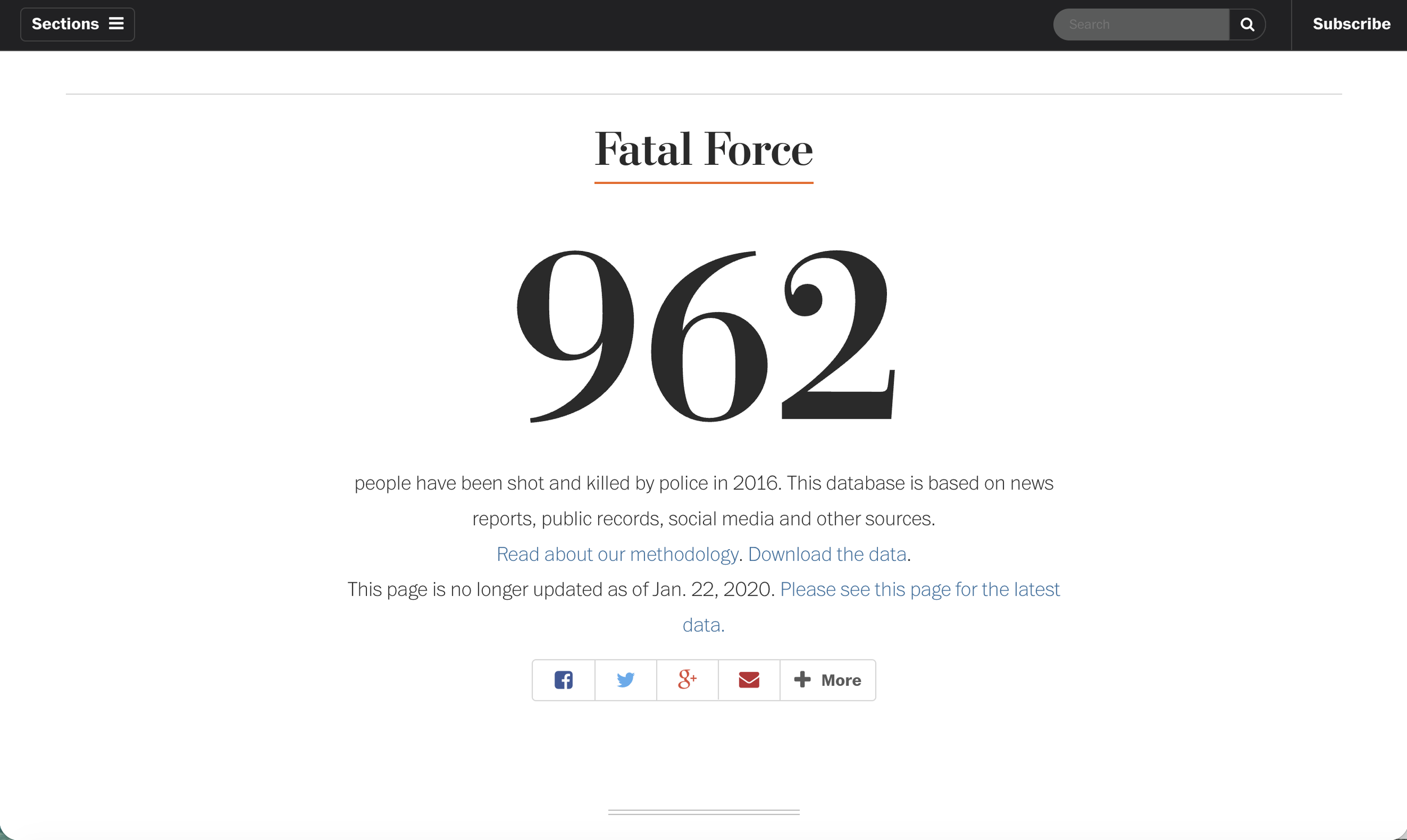
Fatal Force
ACCOUNTABILITY · DATA
Photo research · Photo editing
My role here was specific to photo research and photo editing, but the work carried real weight. I researched and edited photographs of civilians killed by police, tracking down images through local news organizations across the country and, often, calling families directly. These conversations required care, patience and a clear sense of responsibility to people behind the data.
This series was awarded the Pulitzer Prize for National Reporting in 2016.